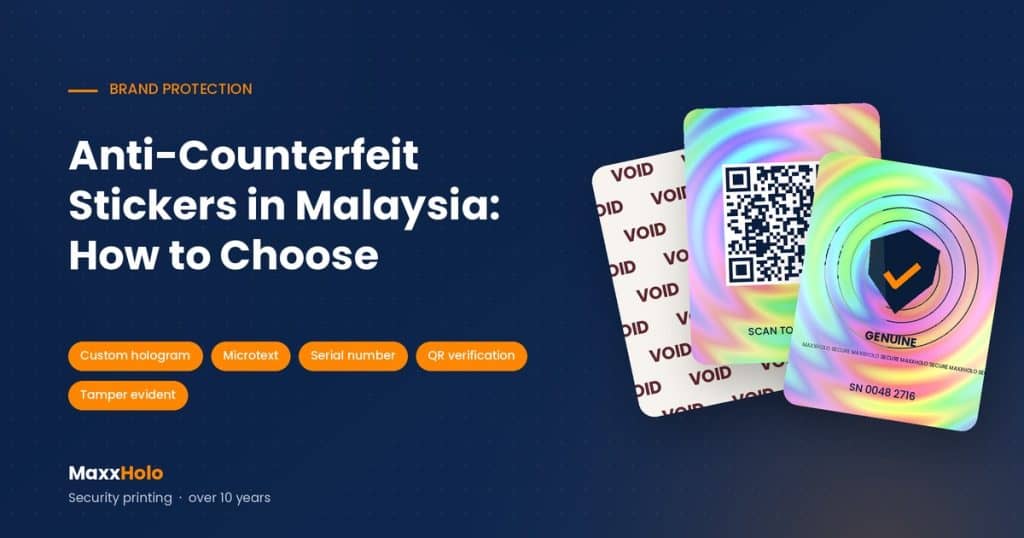
Counterfeit products are a real cost for brands in Malaysia and across Southeast Asia. Fakes are sold on marketplaces, genuine packs are refilled with cheaper product, and stock meant for one market turns up in another. An anti-counterfeit sticker is one of the simplest ways to fight back: a security label on your product that is hard to copy, shows if the pack has been opened, and lets customers check that what they bought is real.
This guide explains the main types of anti-counterfeit stickers used in Malaysia, the security features that make a label hard to copy, and how to choose the right combination for your product.
What Is an Anti-Counterfeit Sticker?
An anti-counterfeit sticker is a security label that protects a product in one or more of three ways:
- It is hard to copy. Features such as a custom hologram, microtext or special inks make it difficult for counterfeiters to reproduce the label.
- It shows tampering. If someone peels or removes the label, it leaves a clear sign, so a genuine pack can’t be opened, refilled and resealed unnoticed.
- It can be verified. A unique serial number or QR code lets customers, distributors or your own team check that each item is genuine.
The strongest labels combine all three. A sticker that only looks shiny, but can be bought off the shelf by anyone, does very little to stop a determined counterfeiter.
Why Brands in Malaysia Use Anti-Counterfeit Stickers
- To protect customers. In skincare, health supplements and other products people consume or apply, a fake can cause real harm.
- To protect revenue and reputation. Every fake sold is a lost sale, and a bad experience with a fake is often blamed on the genuine brand.
- To answer the question “Is this original?” Customers increasingly ask before they buy. A label they can check gives them a clear answer.
- To control distribution. Serial numbers and scan records help brands see where stock ends up and spot products sold outside authorised channels.
The Main Types of Anti-Counterfeit Stickers
1. Custom hologram sticker
A custom hologram sticker carries an image made specifically for your brand. The design changes as the label is tilted under light and is produced from a custom master, which makes it difficult and costly to recreate. It is the most widely recognised visual security feature. Note that a holographic sticker printed on stock rainbow film is not the same thing; our guide on holographic vs hologram stickers explains the difference.
2. QR code hologram sticker
A QR code hologram sticker combines a custom hologram with a unique QR code and serial number on every label. The hologram proves the label is genuine; the QR code lets each individual product be checked with a phone.
3. Void sticker (tamper-evident label)
A void sticker leaves a “VOID” pattern on the surface when it is peeled off, so anyone can see a pack has been opened. It is used to seal boxes, cartons, caps and closures.
4. Breakable warranty sticker
A breakable warranty sticker, also called an eggshell or destructive label, breaks into small pieces when someone tries to remove it, so it can’t be lifted and reused on another product. Our comparison of void and breakable stickers helps you choose between the two.
5. Security packaging with QR code and serial number
For some products, the security feature can be printed directly on the box. A security packaging box carries a unique QR code and serial number on every box, linked to an authentication system.
| Type | Main job | Best for |
|---|---|---|
| Custom hologram sticker | Hard to copy; instant visual check | Products that are being copied |
| QR code hologram sticker | Visual check plus per-item verification | Brands whose customers ask “Is this original?” |
| Void sticker | Shows if a pack was opened | Boxes, cartons, caps and closures |
| Breakable warranty sticker | Can’t be removed and reused | Warranty seals, electronics, screws |
| Security packaging box | Verification printed on the pack | Brands that want security built into packaging |
Security Features That Make a Sticker Hard to Copy
The type of label is only half the story. What really matters is the security features built into it. The most useful ones are:
- Custom hologram master. The hologram image is originated for your brand, so the same design can’t simply be bought on the market. Combining several hologram effects in one design makes it harder still to imitate.
- Microtext. Text printed so small it looks like a line to the naked eye, but becomes readable under magnification. Most copying methods can’t reproduce it sharply.
- Laser-engraved serial numbers. A unique number engraved on each label, so every item can be identified and duplicates stand out.
- UV ink. Marks that are invisible in normal light and appear under a UV torch, for checks by your own team or distributors.
- Colour-shifting ink (OVI). Ink that changes colour when the label is tilted, a quick check anyone can do.
- Hidden text. Covert details that only you know where to look for, useful as evidence if a case goes further.
- Unique QR code. A different code on every label, linked to a verification system rather than a single web page.
Build Protection in Layers
No single feature makes a product impossible to fake. Counterfeiters copy whatever is easiest, so the goal is to add layers until copying is no longer worth it. A practical way to think about it:
| Level | What it includes | What it stops |
|---|---|---|
| 1. Visual | Custom hologram with your brand design | Casual copies and look-alike packaging |
| 2. Identified | Hologram plus microtext and laser-engraved serial numbers | Bulk copies; every genuine label can be traced |
| 3. Verified | Unique QR code linked to an authentication system | Fakes that pass a visual check; customers can verify each item |
| 4. Sealed | Tamper-evident void or breakable layer, plus hidden UV features | Refilled or resealed genuine packs; gives evidence for enforcement |
Most brands start at level 1 or 2 and add verification and tamper evidence as they grow.
Hologram or QR Verification: Which Do You Need?
They solve different problems, which is why many brands use both. A hologram proves that the label is genuine: it is hard to copy and easy to recognise. A unique QR code proves that the individual product is genuine, and every scan gives you data.
With an authentication system such as GoOri, each scan records when and where it happened. Unusual patterns, such as scans from a market you don’t sell in, can point to fakes or parallel imports. The same system can also handle warranty registration, stockist and agent records, and promotions like scan and win. Our guide on how QR code authentication works explains this in more detail.
What to Look For in an Anti-Counterfeit Sticker Supplier
- A custom hologram design for your brand, not stock holographic film with a logo printed on it.
- Unique codes per item, not one code repeated across a whole batch.
- A real verification system with scan records, not just a QR code that opens a web page.
- An artwork proof before production, so you can check every detail before printing.
- Samples you can hold and test on your actual product and packaging.
- Discretion. Many brands prefer not to reveal who makes their security labels. A specialist supplier should respect that.
- Consistent repeat supply, so every batch matches and your customers always see the same genuine label.
What Affects the Price?
The cost of an anti-counterfeit sticker depends on the label size, the quantity, and the security features you choose. For a new custom hologram, the design has to be originated first, so the first order includes that setup. Minimum orders also vary by product. At MaxxHolo, custom hologram stickers and void stickers start from 5,000 pcs, and breakable warranty stickers from 1,000 pcs.
Frequently Asked Questions
Are anti-counterfeit stickers impossible to copy?
No label is impossible to copy, but the right combination of features makes copying difficult, expensive and easy to detect. Layering a custom hologram with serial numbers, a unique QR code and tamper evidence gives far stronger protection than any single feature.
Can customers check if a product is genuine themselves?
Yes. With a unique QR code on each label, customers scan it with their phone and see straight away whether the product is genuine.
Can anti-counterfeit stickers include our logo?
Yes. A custom hologram is designed around your brand, and your logo and wording can be included in the hologram design and printed details.
Which industries use anti-counterfeit stickers?
They are widely used for skincare and beauty products, health supplements, beverages and other FMCG goods, electronics and spare parts, and anywhere a warranty or genuine-product guarantee matters.
Getting Started
MaxxHolo has over 10 years of experience in security printing and has protected more than 500 brands across Southeast Asia, from custom hologram stickers and tamper-evident labels to QR authentication with GoOri. We send an artwork proof before production and can provide samples so you can test the label on your product. Contact us to find the right anti-counterfeit sticker for your brand.